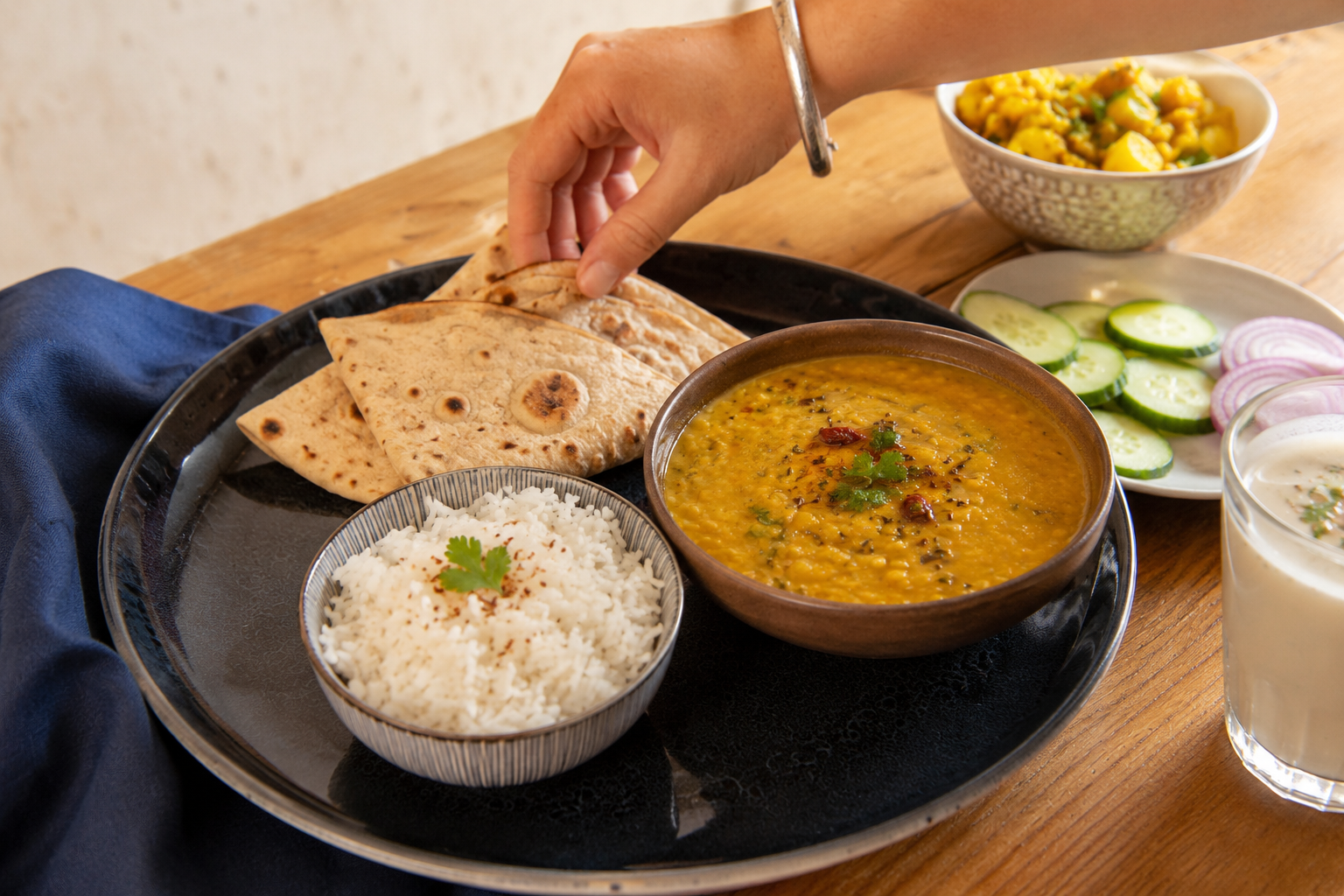
For most Indians, healthy eating does not begin with imported superfoods or neatly measured salads. It begins with the everyday plate: dal, roti, sabzi, rice, curd, pickle, and sometimes a spoon of ghee because food is also comfort. Yet, when it comes to nutrition tracking, this familiar plate becomes surprisingly difficult to measure.
The challenge is simple: Indian meals are rarely standardised. One home’s dal may be light and watery while another may be thick, rich, and finished with tadka. One roti may be small and dry, while another may be larger, softer and brushed with ghee. This is where traditional calorie tracking often struggles.
Why are Indian Meals Difficult to Track?
Most calorie trackers are built around fixed portions, packaged foods, and predictable recipes. Indian meals work differently. A pinch of masala, a splash of oil, half a katori of dal, two rotis, one serving of sabzi and a little rice can vary widely from one kitchen to another.
This makes estimating Indian meal calories confusing for users trying to lose weight, build muscle, manage lifestyle conditions or simply eat more consciously. Even when the food looks the same, the nutrition can change based on portion size, cooking method, ingredients, and oil usage.
Aloo sabzi, bhindi sabzi, paneer sabzi, and mixed vegetables cannot be logged as one generic entry. A home-cooked Indian meal needs context, and that context is often missing in standard nutrition apps.
The Roti and Chapati Confusion
Ask ten people how many calories are in one roti, and you may get ten different answers. That is because calories in roti depend on flour quantity, size, thickness and whether oil or ghee has been used.
The same confusion appears when people search for calories in chapati. While roti and chapati are often used interchangeably, the actual calorie values can still differ. A small phulka made without oil is very different from a larger chapati cooked with ghee.
This creates a common tracking gap. A user may log “one roti” in an app, but the number shown may not match what was eaten. Over time, these small errors can affect progress, especially for people closely monitoring calories, protein, carbs or fat.
Dal and Rice are Not Always Simple
Dal is often seen as one of the healthiest parts of an Indian meal, and rightly so. It can offer protein, fibre, and satiety. But tracking calories in dal is not always straightforward. Moong dal, toor dal, masoor dal, chana dal and dal makhani all have different nutritional profiles. Add tadka, ghee, coconut, cream or extra oil and the numbers shift again.
Rice brings another layer of complexity. Estimating calories in rice depends heavily on cooked quantity and preparation style. A small katori of plain rice, a large serving of jeera rice, vegetable pulao, curd rice or khichdi cannot be treated the same way.
For many users, this is where tracking becomes tiring. The meal is simple to eat, but difficult to log accurately.
Why Manual Tracking Feels Exhausting?
Manual nutrition tracking often expects users to weigh food, search every ingredient, calculate cooking oil and estimate serving sizes. That may work for packaged foods, but it does not reflect how most Indian households cook and eat.
Most people do not prepare dal by calculating grams of lentils per serving. They do not measure how much oil remains in sabzi after cooking. They may not know whether their roti weighs 30 grams or 45 grams. Daily life rarely allows that level of kitchen mathematics.
This creates a gap between motivation and consistency. People want to track their meals, but the process becomes too technical. Eventually, logging turns into guesswork and guesswork turns into frustration.
How Can AI Make Tracking Smarter?
This is where an AI nutrition app can make a meaningful difference. Instead of forcing users to manually decode every meal, AI can help simplify food recognition, portion estimation and nutritional breakdowns for Indian eating patterns.
A smart AI diet planner can go beyond basic calorie counting by offering goal-based suggestions, meal insights and personalised guidance. It can help users understand whether their plate needs more protein, fewer refined carbs, better portion control or a more balanced distribution across the day.
The real benefit of AI is consistency. When tracking becomes easier, users are more likely to continue. Instead of making nutrition feel like homework, AI can make it feel like a helpful daily nudge.
Nutriiya Understands the Indian Plate
Nutriiya is designed for people who want nutrition tracking to feel simple, practical, and relevant to the way Indians actually eat. Instead of treating Indian food as a complicated exception, Nutriiya focuses on everyday meals like dal, roti, sabzi, rice, poha, dosa and khichdi.
Its India-first approach helps bridge the gap between traditional home food and modern health goals. Users can better understand their meals, stay aware of portions and make smarter choices without turning every lunch into a spreadsheet.
Final Thoughts
Dal, roti, sabzi, and rice may look simple, but nutritionally, they are layered with variations. Portion size, preparation style, ingredients and cooking methods all influence the final calorie count.
For Indian users, the biggest challenge in nutrition tracking is not lack of discipline. It is the lack of tools that understand how Indian meals are cooked, served and eaten.
With smarter AI-led tracking and a deeper understanding of Indian food habits, Nutriiya helps make healthy eating feel less complicated, more consistent and far more achievable.
Share this blog on: